The History of the Medieval World: From the Conversion of Constantine to the First Crusade by Susan Wise Bauer
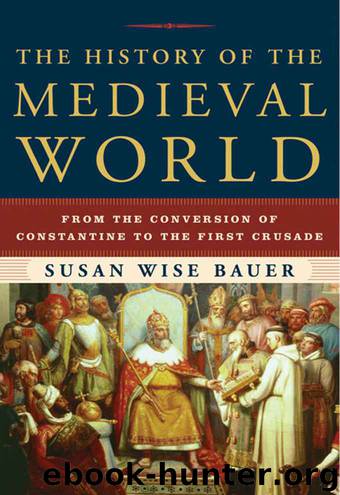
Author:Susan Wise Bauer [Bauer, Susan Wise]
Language: eng
Format: epub, mobi
Publisher: W. W. Norton & Company
Published: 2010-02-22T08:00:00+00:00
Zachary, facing the hostile Aistulf, was willing to trade the church’s approval for protection from the Lombards.
Pippin ordered Childeric III tonsured and sent to a monastery, where he died five years later, the last of the Merovingians. Pippin was crowned the first king of the Carolingian dynasty in the city of Soissons, in a brand-new sacred ceremony that involved anointing with holy oil in the manner of an Old Testament theocratic king.*
Zachary died in 752, but his successor, Pope Stephen II, was careful to put himself in a position to reap the benefits of that coronation. In 754, he travelled north into the lands of the Franks and re-anointed Pippin in an even more elaborate ceremony, which also included the anointing of his sons, seven-year-old Charles and three-year-old Carloman, as his heirs. “At the same time,” according to an anonymous addition to Gregory of Tours’s history of the Franks, “he bound all the Frankish princes, on pain of interdict and excommunication,† never to presume in future to elect a king begotten by any men except those confirmed and consecrated by the most blessed pontiff.”5
He had tied the Frankish king’s power to the authority of the pope, and King Pippin responded by marching across the Alps down into Italy, driving Aistulf out of the papal lands and the lands once governed by the exarch, and giving all of them to the pope. Aistulf’s army was badly defeated, and he was forced to recognize Pippin as his overlord. After Aistulf was thrown from his horse while hunting, and died in 756, Pippin chose the Lombard nobleman Desiderius to be the next king of Italy. In half a decade, he had become not only king of the Franks but the de facto ruler of Italy as well.6
Pope Stephen II didn’t do badly either. He now ruled over a much expanded papal kingdom, which included both Rome and the old imperial center of Ravenna. To justify his possession of these lands, he presented Pippin with a document that (he claimed) had been written by Constantine and had been in the possession of the church ever since. In it, Constantine explained that the fourth-century pope Sylvester had healed him of a secret case of leprosy. In gratitude, he decreed that the papal seat “shall be more gloriously exalted than our empire and earthly throne,” that the pope would henceforth be supreme over “the four chief seats [of the church]—Antioch, Alexandria, Constantinople, and Jerusalem—as also over all the churches of God in the whole world,” and that Constantine himself was handing over to the pope “the city of Rome and all the provinces, districts and cities of Italy…. We are relinquishing them, by our inviolable gift, to the power and sway of himself and his successors.”7
This document had been forged by some talented cleric, and the ink on it was barely dry. Pippin, who was not an idiot, undoubtedly knew this. But the popes had given him the authority he craved, and in return he was willing to award them power over Rome and the surrounding lands.
Download
The History of the Medieval World: From the Conversion of Constantine to the First Crusade by Susan Wise Bauer.mobi
This site does not store any files on its server. We only index and link to content provided by other sites. Please contact the content providers to delete copyright contents if any and email us, we'll remove relevant links or contents immediately.
| Africa | Americas |
| Arctic & Antarctica | Asia |
| Australia & Oceania | Europe |
| Middle East | Russia |
| United States | World |
| Ancient Civilizations | Military |
| Historical Study & Educational Resources |
Room 212 by Kate Stewart(5119)
The Crown by Robert Lacey(4814)
Endurance: Shackleton's Incredible Voyage by Alfred Lansing(4780)
The Iron Duke by The Iron Duke(4354)
The Rape of Nanking by Iris Chang(4211)
Joan of Arc by Mary Gordon(4109)
Killing England by Bill O'Reilly(4001)
Say Nothing by Patrick Radden Keefe(3984)
I'll Give You the Sun by Jandy Nelson(3447)
Shadow of Night by Deborah Harkness(3367)
Hitler's Monsters by Eric Kurlander(3342)
Mary, Queen of Scots, and the Murder of Lord Darnley by Alison Weir(3210)
Blood and Sand by Alex Von Tunzelmann(3203)
Eleanor & Park by Rainbow Rowell(3172)
Darkest Hour by Anthony McCarten(3130)
Margaret Thatcher: The Autobiography by Thatcher Margaret(3082)
Book of Life by Deborah Harkness(2938)
Red Famine: Stalin's War on Ukraine by Anne Applebaum(2933)
The One Memory of Flora Banks by Emily Barr(2863)
